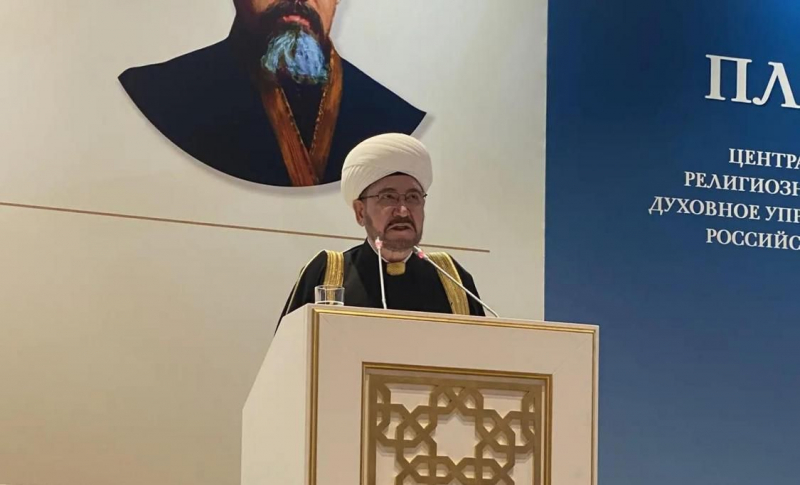
 Report by the Chairman of the Religious Board of Muslims of the Russian Federation, Grand Mufti Sheikh Ravil Gaynutdin, at the Plenum of the RBM and the XII Fakhretdinov Readings, September 22, 2026:
I cordially greet you with the words of the brotherly Muslim greeting:
اَلسَّلَامُ عَلَيْكُمْ وَرَحْمَةُ ٱللَّٰهِ وَبَرَكَاتُهُ
Peace be upon you, the mercy of Almighty Allah, and His blessing!
Today we honor the memory of the founder of Tatar religious reformism, Gabdennasyr Kursavi. He was born 250 years ago and became a herald of changing paradigms of thought in the Turkic-Tatar ummah of inner Russia, influencing the further intellectual development of the ummah of the Russian Empire and the entire world. Kursavi's main idea, which later attracted Shihabutdin Marjani and other of our great thinkers, was the rejection of scholastic reasoning within the framework of taqlid—blind imitation of predecessors—in favor of independent rational judgment. Kursavi was convinced that the faith that is alive is one saturated with a deep and clear understanding of the essence of religious principles, based on the study of religious sources and free in intellectual inquiry.
Such ideas threatened the scholar and mudarris not only with obstruction among the official clergy but even with the death penalty. However, the views of Gabdennasyr Kursavi were his sincere and firm conviction and became a decisive step on the path of further reform and renewal of our theological thought. Thanks to this, our Russian ummah entered the historical era commonly called Modern Times as an intellectually and socially developing organism.
In the same years when Kursavi was engaged in enlightenment, the printing of the Holy Quran and Muslim book publishing in general were actively developing in Russia. The first printed Quran was published in Russia in 1787, whereas in Ottoman Turkey, which was then the leader and main throne of the Islamic world, the first printed Quran appeared almost a century later—in 1874.
Our brothers in faith and blood—the Belarusian Tatars—created a translation of the meanings of the Holy Quran into the Slavic language as early as the 17th century. A translation of our Holy Scripture into Russian also appeared. It was made by the first Russian doctor of philosophy and medicine, a graduate of the University of Padua, Pyotr Postnikov, in 1697. Thereby he preceded by a year the translation into the main European language of science of that time—Latin—made in the same Padua by Ludovico Marracci, confessor to Pope Innocent XI.
The scholarly research and works of Pyotr Postnikov were directed by the first Russian Emperor, Peter Alekseevich. And the activity of the Russian Muslim first printer, Mullah Usman Ismail, proceeded by the decree of Empress Catherine II.
Thus, the 19th century—the century of scientific and technological progress and the industrial revolution, up to the era of great upheavals at the beginning of the 20th century—the Russian ummah entered as a community marching in the vanguard of the processes of renewal and transformation in the global Islamic ummah. Our ancestors founded Muslim communities and carried the light of enlightenment from faraway Japan and Northern China to New York. A vivid marker of recognition of the merits of Russian Muslims before the world ummah is the election of the Russian Mufti Rizaetdin Fakhretdin as vice-president of the World Islamic Congress in Mecca exactly 100 years ago—in 1926.
Our leading position intellectually and socially was determined by several factors. Among them: the presence of bright, ahead-of-their-time thinkers such as Gabdennasyr Kursavi, Shihabutdin Marjani, Husain Faizkhanov, Ziya Kamali, Ismail Gasprinsky, Musa Bigiev; the formation of national commercial and industrial capital, officialdom, and secular intelligentsia.
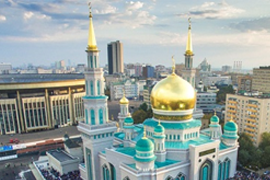
The principled position of Russian sovereigns on the intellectual integration of Islamic heritage into the domestic scientific and academic perimeter was also of decisive importance. Today this policy has received its new embodiment thanks to the policy of Russian President Vladimir Putin, who at the opening of the Moscow Cathedral Mosque after its expansion and reconstruction on September 23, 2015, emphasized the traditions of enlightened Islam on Russian soil. The national leader—the head of state—promised to continue helping to recreate the domestic Muslim theological school and its system of religious education, and he kept his word.
Today, with the support of the Presidential Administration, the Government of Russia and individual ministries and departments, the Government of Moscow and the authorities of many other subjects of the federation, as well as thanks to the highly professional work of the Foundation for Support of Islamic Culture, Science and Education, we are implementing many projects relevant for today and for the future—for future generations. In order to pass on to younger generations the spiritual, cultural, and moral code inherent in traditional Islam in Russia, Islamic madrasahs, colleges, and institutes are working, new mosques are being built and historical ones restored, and our book and manuscript scholarly heritage is being restored bit by bit.
Taking this opportunity, since the topic of state-Islamic interaction has come up, I express our sincere congratulations on the successful holding of elections in the Russian Federation and prayerful wishes for success in the development of the country and the achievement of good for its inhabitants to the politicians and political parties for whom our citizens cast their votes.
Dear brothers and sisters!
You know that in December of last year we held the first Friday prayer in the restored First Tatar Mosque—as the Historical Mosque of Moscow has been known since ancient times. Work on this complex is not complete; currently, with the support of the Republic of Tatarstan, restoration work is underway in the historic building of the Erzin Madrasah.
Today, restoration and major repair work is in full swing at the Donetsk Cathedral Mosque, which was first hit by rocket shells back in 2014 and has not functioned for 12 years. In the near future, restoration will begin on the Khan's Mosque of Kasimov—the oldest surviving Muslim house of worship in the central European part of Russia—as well as two tekiye of the Chingizids. Repair and restoration work has been carried out for the 120th anniversary at the New Mosque of Kasimov, built in 1906. Next year marks the 200th anniversary of the construction of the Fair Mosque of Nizhny Novgorod. Today this house of worship is being revived anew, and an Islamic Cultural Center is under construction within the Nizhny Novgorod Cathedral Mosque complex. I thank my deputy, Managing Director Rafik Anvarovich Fattakhetdinov, for his tireless labors in expanding and renewing Muslim infrastructure in our country. Construction is also nearing completion on the mosque in Khabarovsk and the mosque of the "Nur-Islam" mahalla in the Polevskoy district of Sverdlovsk Region, with the financial participation of the RBM. By the will of the Almighty, today we will witness a significant event—the installation of the crescent on the central dome of our administrative building. Soon the new—fourth—floor of the administrative building will be put into operation, as the number of staff and structural units of our organization has been steadily growing in recent years.
We see that in the regions too, muftis and imam-mukhtasibs spare no effort to create worthy infrastructure for Muslims and unite concerned people around such projects. The central apparatus tries to assist every local initiative. Collections through the "Zakat" charitable foundation under the leadership of the Mufti of Moscow, Ildar Hazrat Alyautdinov, also play a great role.
The role of the clergy of traditional religions, including Islam, in the public life of the country is growing. We see how work on the spiritual care of servicemen, students of military educational institutions, and personnel of the Rosgvardiya has intensified in recent years. Our imams from all corners of Russia regularly visit the frontline zone. In order to put work with the defenders of the Fatherland in the Special Military Operation on a systematic basis, several energetic young imams and imam-mukhtasibs have been seconded to the Donetsk People's Republic. Imams are also actively working to provide care for wounded soldiers in hospitals.
I sincerely thank all our associates from the regions and the central apparatus who have made support for the Special Military Operation part of their lives—and this is hundreds and thousands of people across Russia, from muftis to volunteers from remote areas. At the same time, we expect that work to support the SMO will be intensified in the coming months, including through improved coordination between grassroots initiatives and the work of the central apparatus, as well as through expanding the social base of humanitarian aid. Every day we receive both thanks for humanitarian aid to the front and testimonies that combatants expect from us, above all, spiritual and moral support, our duas and guidance. From all the military commanders with whom I have had occasion to communicate over the years of the Special Military Operation, I invariably hear two facts. First—Russian Muslims fight in the SMO selflessly and heroically. Second—in the zone of the special operation there reigns a combat brotherhood that knows no national or religious strife, no division or belittlement. In Tatarstan alone, since the beginning of the special operation, 19 people—among them people of different nationalities—have earned the title of Hero of Russia. And if we speak of our Muslim Russian ummah, not a day passes when we do not receive news of heroism, fortitude, and devotion to the Fatherland on the part of Muslim soldiers. And as Russian President Vladimir Putin rightly said at the plenary session of the St. Petersburg International Economic Forum to the minister from Saudi Arabia—our Muslims have no other Motherland. Therefore, for this country, its unity and integrity, we will stand to the end.
The head of state did not accidentally declare 2026 the Year of Unity of the Peoples of the Russian Federation, since internal accord and unity today are the main component of our victory. Our great enlightener and thinker Ismail Gasprinsky, whose 175th anniversary we mark this year, said: "It is known that unity is strength, and discord is the ruin of people in general and in all spheres of life." Those public groups and associations that today have raised the banner of pitting peoples against each other are acting against the policy of the President and the natural interests and aspirations of our state.
The entire ummah is, of course, concerned about the fate of Muslim religious figures detained in various regions. Many of them we have known for many years as law-abiding, patriotic people faithful to high moral principles. Hardest of all is it for the families of these detainees, their closest circle, who have found themselves in complete confusion. Preconditions have been created for the emergence of unrest and provocations, which must not be allowed. What we are experiencing is a test of our faith and fortitude of spirit. We stand by our fellow believers and place our trust, above all, in the mercy of Almighty Allah, as well as in just state justice. For the Lord has said in the Quran:
وَقُلْ جَآءَ ٱلْحَقُّ وَزَهَقَ ٱلْبَـٰطِلُ ۚ إِنَّ ٱلْبَـٰطِلَ كَانَ زَهُوقًا
"Say: 'The truth has come, and falsehood has vanished. Indeed, falsehood is bound to vanish.'" (17:81)
We believe that the truth will sooner or later appear, and the innocence of our righteous brothers will be proven.
Dear brothers and sisters!
We are witnesses to and participants in a unique moment in world history, when strong ties with the East, Asia, and the African and Arab South completely thwart the plans of the collective West to organize a diplomatic, economic, scientific, and technical blockade of Russia. The annual "Kazan Forum" in the capital of Tatarstan, the Eastern Economic Forum in Vladivostok, and the BRICS and ASEAN summits held in our country are increasingly revealing the potential for cooperation with the Global South, the intensification of historical transcontinental transport routes, and the creation of new trade routes.
For centuries, the delicate and complex mission of interpreters, diplomats, and mediators for the Russian state was carried out by our ancestors—graduates of Islamic madrasahs who were fluent in Arabic, Persian, and Turkish. Thanks to their labors and talents, the ummah also prospered, mosques were built, and waqfs were established. Our ancestors left a huge cultural and scholarly heritage that is extremely in demand in the world today and valuable to the global Islamic ummah.
Times have changed. Today our children attend not maktabs at the mahalla but state general educational institutions; our Islamic institutes have state accreditation and issue state-standard diplomas. The holder of such a diploma subsequently has the right to prepare a dissertation and defend it in a state dissertation council and to receive a scholarly degree recognized by the state and internationally. There is even the possibility of studying Arabic in state schools in order to subsequently take the Unified State Exam in this subject. This is a new reality that just 40-50 years ago our Muslims could not even imagine, for state policy was a course toward the imminent complete victory of atheism—godlessness.
And today, thanks to the created conditions for scholarly and intellectual development, we are experiencing an intellectual revival and publish dozens of books a year. We—Muslims, not the academic community—have brought to light from the archives the oldest translations of the meanings of the Holy Quran and produced full scholarly editions of them. Today these works—I mean the aforementioned translation of Dr. Pyotr Postnikov, published by us—are held in the Vatican Apostolic Library, in the Center of Islamic Civilization of Uzbekistan, and in other major book collections. And wherever we travel abroad—whether to Saudi Arabia, Iran, the United Arab Emirates, Egypt, Malaysia, Uzbekistan, Turkey, Algeria, and many other countries—the attitude toward the Russian ummah is as toward an enlightened ummah, which, thanks to strong faith and an ancient theological school, was able to pass through the trials of the atheistic period.
Thanks to this reputation in the eyes of the Islamic world, Kazan was able to achieve the status of cultural capital of the Islamic world in 2026, and the first event on this occasion was the International Quran Prize, held by the Religious Board of Muslims of the Russian Federation together with the Ministry of Culture of the Republic of Tatarstan. I express gratitude to my deputy for international affairs and hajj, Mufti Rushan Abbyasov, for his effective work in building the international contour of the activity of Russian Muslims. Taking this opportunity, we congratulate the Strategic Vision Group "Russia – Islamic World," in which I have had the honor to work since its founding, on its 20th anniversary and wish the group every success and the help of the Almighty.
Dear brothers and sisters!
For the 25,000 Russian pilgrims who have received a quota to perform Hajj, active preparatory work is beginning. Hajj occupies a special place in the life of a Muslim. A person prepares for this worship for years, and our duty is to help him perform the pilgrimage calmly, with dignity, and in accordance with the established order. Next year the official hajj operator of the Religious Board of Muslims of the Russian Federation, "Muslim Tour," will mark its 30th anniversary. Over these decades, many thousands of pilgrims have passed through its care. Trust in the operator was built not on promises but on work year after year: timely processing of documents, organization of the trip, accompaniment of people, and readiness to answer for them at every stage of the journey. It is especially important that "Muslim Tour" knows the needs of our pilgrims and works in constant interaction with foreign partners. Its reliability is recognized both by those who have entrusted their pilgrimage to it and by those with whom organizational matters are resolved on the host side. For us this is of fundamental importance. In sending a person on Hajj, we bear responsibility before them and must be confident in those to whom we entrust their accompaniment. Therefore I strongly ask you to direct future pilgrims from your regions through our official hajj operator "Muslim Tour." I ask you to personally give attention to this work: timely convey information to imams and communities, help people prepare documents, and explain the procedure for contacting the operator.
I particularly emphasize: this year the acceptance of documents for Hajj ends on December 31, 2026. This deadline is set in accordance with the requirements of the authorities of Saudi Arabia. I ask you not to postpone the work to the last days, so that none of our fellow believers loses the opportunity to perform Hajj due to untimely submission of documents. May Almighty Allah ease the path for everyone who intends to visit the sacred places, and accept their worship.
Thank you for your attention!
During the opening of the forum we recited sacred verses of the Quran. I want, together with you, to remember our brothers who have passed away during the reporting period and ended their earthly lives.
In August, Mufti and first President of the Chechen Republic, Hero of Russia Akhmat Haji Kadyrov, would have turned 75;
Fayaz Sharipovich Khuzin, renowned archaeologist, Doctor of Historical Sciences;
Jamal Yakubovich Rakhaev, Caucasus scholar, staff member of the Institute of Russian History of the Russian Academy of Sciences;
Ziya Salikh uly Salikhov, veteran of the Great Patriotic War, honorary member of the Muslim community of the Kaliningrad Region;
Rashit Hazrat Khayretdinov, chairman of the local Muslim religious organization of the village of Semenovka, Krasnooktyabrsky district of Nizhny Novgorod Region, who died while performing Hajj;
Nur Hazrat Musakaev, former imam-khatib of the local Muslim religious organization "Rukh" in the city of Orenburg, who perished in the SMO;
Akram Hazrat Sadykov, chairman of the local Muslim religious organization of the village of Vershinskaya in Tyumen Region, father of 10 children.
I will conclude my speech with an instruction and appeal addressed to each of you: to make proper use of the opportunities with which the Almighty has endowed our modern generation of Russian Muslims, to invest in knowledge, in social development, and to be devoted sons and daughters of our dear Fatherland, a support for society and the state. Dear brothers and sisters!









Official site of Russia mufties Council
The operation of the website is financially supported by non-commercial charitable foundation "Fund for support of Islamic culture, science and education"
© 2013 - 2026