Rushan Abbyasov spoke about the significance of the cultural capital status in the Islamic world.
The International Quran Prize in Kazan opened the series of events under the auspices of the cultural capital of the Islamic world. Rushan Abbyasov, Deputy Chairman of the Religious Board of Muslims of the Russian Federation (RBM) for International Affairs, told Tatar-inform about the meaning of this status in the Islamic world and how the capital of Tatarstan is perceived abroad.
"In Islamic tradition, any good deed begins with the mention of the Almighty's name"
– Kazan is the cultural capital of the Islamic world. What can you say about the significance of this status for Russia? What does this status mean globally?
– The designation of Kazan as the cultural capital of the Islamic world is recognition of Russia's special role as a country where Islam has deep historical roots and organically develops within a multinational and multi-religious society. For our country, this is, above all, evidence of trust from the international Muslim community and confirmation that Russia's experience of peaceful coexistence of religions and cultures is valued and arouses genuine interest.
Islam has a centuries-old history on the territory of Russia. We remember that in 2022, on the initiative of the Chairman of the Religious Board of Muslims of the Russian Federation, Grand Mufti Sheikh Ravil Gaynutdin, and with the support of Russian President Vladimir Putin, we marked the 1100th anniversary of the adoption of Islam by the peoples of Volga Bulgaria at the federal level, while the first traces of Islam on the territory of our country date back to the time of the companions of the Prophet Muhammad (peace be upon him) and are associated with the city of Derbent. These are important historical foundations that shape our modern religious and cultural space.
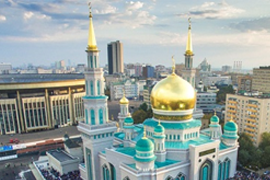
In this context, Kazan was chosen not by chance. It is one of the largest centers of Islamic culture in Eurasia, a city where different religions and cultures have developed in good neighborliness for centuries. The Kazan Kremlin itself is a clear symbol of this unity, with a mosque and an Orthodox church located side by side, reflecting the unique experience of harmonious coexistence.
In the global context, this status emphasizes Russia's openness to dialogue with the Islamic world and its readiness to serve as a platform for cultural, spiritual, and humanitarian interaction. Kazan becomes a magnet for scholars, theologians, cultural figures, and public leaders, helping to strengthen ties between peoples and foster an atmosphere of mutual respect and cooperation.
Undoubtedly, in the modern world, this status is also perceived as a sign of high respect from the Islamic world towards Russia and its Muslim community, as well as confirmation that our path of development based on traditional spiritual and moral values and mutual respect resonates and finds support on the international stage.
"It is symbolic and truly significant that the program of the year 'Kazan – Cultural Capital of the Islamic World' opens with the International Quran Prize, that is, with the sound of the Divine Word"
– Why is it important that the series of cultural events is opened by the International Quran Prize?
– In Islamic tradition, any good deed begins with the mention of the Almighty's name. This is not merely an established norm but a profound spiritual principle that sets the right tone and meaning for everything that follows.
This is precisely why it is symbolic and truly significant that the program of the year "Kazan – Cultural Capital of the Islamic World" opens with the International Quran Prize – that is, with the sound of the Divine Word. I am convinced that such a spiritual start will be warmly received in the Islamic world and will be highly appreciated as a demonstration of respect for tradition and the very origins of Islamic culture.
To some extent, this is also our thoughtful innovation. We have not seen other countries begin their cultural capital year with the recitation of verses from the Holy Quran. This approach emphasizes the priority of spiritual values and sets a high meaningful benchmark for the entire subsequent program.
It is also important that this format combines spiritual content with a modern cultural form. Through the competition, through theatrical productions, through the living sound of the Quran, we not only preserve tradition but also make it understandable and accessible to a wide audience – both in Russia and beyond.
I am confident that this approach will be received with interest and may even become a model for other countries seeking to organically combine spiritual heritage with modern cultural practices.
"Participants in our events are internationally recognized experts in the Quran and masters of the art of beautiful recitation, prize-winners of many international competitions and awards"
"We strive to reach out to intellectuals, civil servants, cultural figures, youth, people of different views and professions"
– What is the purpose of holding this event in Russia? What meanings do you invest in it?
– Participants in our events are internationally recognized experts in the Quran and masters of the art of beautiful recitation, prize-winners of many international competitions and awards.
Our goal is to give every person in our multinational society the opportunity to come into contact with the primary source of Islam – the Holy Quran. Through art, through the beauty of the recitation of the sacred verses, we strive to convey to people's hearts the true meanings of Divine Revelation.
The Almighty Creator Himself calls the Quran a sure guide for people – a source from which one can draw inspiration, find tranquility, healing, and answers to the various questions that life poses. Sometimes a person is overcome by despondency, despair, anxiety, and it is true faith in Almighty Allah, the awareness of His closeness, help and support, that helps overcome life's trials. The verses of the Holy Quran are imbued with these meanings and resonate from the stages of Russia's leading halls.
We have long stepped beyond the confines of mosques alone. For those who wish to hear the recitation of the Quran, the doors of mosques are always open.
But there are people who may not yet be ready to come to the mosque. That is why we strive to reach out to intellectuals, civil servants, cultural figures, youth, people of different views and professions, so that through the beauty of Quranic recitation and spiritual-educational productions, we can reveal to them the depth of the Islamic tradition.
One of my favorite surahs, often recited by renowned reciters, is Surah Ar-Rahman. It reminds us of the need to be in a state of gratitude to Almighty Allah every day for the blessings that surround us. The verses of this surah, like many other verses of the Quran, enumerate the countless mercies with which the Creator has endowed man. The Lord draws our attention to the signs within ourselves: for the very ability to see, hear, create, and live with dignity, we must be grateful to the Creator.
As stated in the Holy Quran, one should invite to the path of Allah with wisdom and good admonition. This principle is at the heart of our events: not to repel, but to open; not to lecture formally, but to speak to people in the language of beauty, meaning, and spiritual depth.
"The competition was extremely high, and unfortunately, according to the jury's evaluation, our participants did not make it to the finals"
– This year there are no finalists from Russia in the competition. How many Russian reciters participated and why, in your opinion, did they not advance? Assess the Russian school of hafiz and reciters.
– The qualifying round saw participants from about 30 countries – reciters of exceptionally high caliber, laureates and prize-winners of major international competitions. The competition was extremely high, and unfortunately, according to the jury's evaluation, our participants did not make it to the finals.
At the same time, we consistently hold the Russian school of hafiz and reciters in high regard. In recent years, a strong school of hifz – memorization of the Holy Quran – has formed in Russia. Our representatives regularly demonstrate commendable results on the international stage, becoming winners and prize-winners of prestigious competitions.
As examples, one can cite reciters such as Ayemiddin Farkhutdinov, who became the first Russian winner of the Moscow International Quran Recitation Competition; Akhmad Shahmamedov, who won a prize at an international award in Tanzania; and Suleyman Bikmaev, who achieved a high result at a competition in Egypt, and many others.
However, when it comes to the "tilawah" category – that is, the culture of correct and melodic recitation of the Quran with deep understanding of meanings and conveying them through intonation – we still have some work to do. This is a very subtle art, requiring not only knowledge of the text but also a high level of performance skill, mastery of maqamat, and the ability to convey the content of the verses through voice.
I am confident that this is a matter of time. The Russian school has a solid foundation, talented young reciters, and as experience accumulates and this tradition develops, we will see increasingly better results in this category as well.
Kazan today is, without exaggeration, a recognizable brand in the Islamic world, one of the key centers of Islamic culture in Eurasia
"Kazan and Moscow are becoming points of attraction where the spiritual agenda is naturally complemented by cultural and tourist interest"
– How are competitions for hafiz held in Russia perceived abroad?
– Overall, competitions and awards for the Holy Quran held in Russia are held in high regard abroad. This is confirmed both by the high level of participants and by recognition from the international community. For example, the Moscow International Quran Recitation Competition was recognized by the Dubai International Prize as one of the best in the world, and in 2010 it was included in the UNESCO program. The Muslim World League awarded our Moscow International Quran Competition a special prize. This indicates recognition of the high organizational level and substantive depth of our events.
Kazan today is, without exaggeration, a recognizable brand in the Islamic world, one of the key centers of Islamic culture in Eurasia. Granting it the status of cultural capital of the Islamic world only strengthens this authority. Foreign guests undoubtedly feel the special atmosphere of this city – its centuries-old history, the harmonious coexistence of religions and cultures, the unique blend of Eastern and Western traditions.
At the same time, both Moscow and Kazan are perceived as important venues for major international events. Moscow – as the capital of the state and a center of business, public, and international activity; Kazan – as the spiritual and cultural center of Russia's Muslims. In this sense, the cities are not opposed but complement each other.
It is also important to note that such events fulfill an important humanitarian mission, popularizing the beauty of our multinational society. Over recent decades, the perception of Russia's Muslims and our society as a whole abroad has changed significantly. This has become possible thanks to the immense efforts of our President Vladimir Vladimirovich Putin, the systematic work of the Ministry of Foreign Affairs and other relevant agencies. A major role is also played by the Strategic Vision Group "Russia – Islamic World" under the leadership of the Rais of the Republic of Tatarstan Rustam Nurgalievich Minnikhanov and the Religious Board of Muslims of the Russian Federation under the leadership of my leader and teacher, Grand Mufti Sheikh Ravil Gaynutdin. I am confident that the participation of renowned reciters, theologians, and public and religious figures in the events of the RBM contributes to the formation of a more objective and profound image of our country.
A notable example is the visit of Imam-Khatib of the Prophet's Mosque (peace be upon him) in Medina, Abdulmuhsin Al-Qasim, who visited Moscow, Kazan, and the regions of the North Caucasus. Upon his return, he gathered his students and colleagues to share his impressions, displayed photo and video materials, and noted that Russia had revealed itself to him in a completely new light. Moreover, he expressed his intention to prepare a separate study dedicated to Russian Islam. Such personal testimonies from authoritative religious figures play an important role in building trust and interest in our country.
When renowned reciters with a multimillion-strong audience come to Russia and share their impressions, showing the beauty of our cities, the level of event organization, and the atmosphere of openness, it makes a strong impression and helps to strengthen trust and mutual understanding.
It is also important that such events have a practical impact, including the development of tourism and humanitarian ties. We see a steady increase in interest in Russia from guests from the Islamic world. People come not only to participate in events but also to learn about the culture, history, and contemporary life of our regions.
This is also reflected in the urban environment: in Moscow, for example, information for tourists, navigation elements, and services are increasingly being duplicated in Arabic and Chinese, indicating growing international interest and adaptation of infrastructure to the needs of foreign guests. In this sense, Kazan and Moscow are becoming points of attraction where the spiritual agenda is naturally complemented by cultural and tourist interest.
It can be said that the International Quran Prize and other similar initiatives are becoming not only significant cultural and religious events but also an important instrument of people's diplomacy and spiritual diplomacy, uniting people and nations.
– Can Russia set trends for global hafiz competitions in terms of the level of event organization?
– Russian Quran competitions and awards indeed have a number of features that already arouse interest and resonate abroad. We try not just to hold a contest but to create a holistic cultural and spiritual space that reveals the depth of the Holy Scripture.
One such direction is the format of theatrical spiritual-educational productions that organically complement the recitation of the Quran. Through artistic imagery, scenography, music, and live recitation of verses, we strive to convey the meanings of Revelation more broadly and accessibly to the viewer. For many countries of the Islamic world, this synthesis of tradition and modern cultural form has become a new and largely inspiring experience.
We pay special attention to the development of the "tilawah" category. This focus also contributes to growing interest in the performance skills of reciters and raising the overall level of competitions.
To a certain extent, it can be said that this approach is our contribution to the development of the international Quran competition movement. We see that certain elements, whether stage solutions, presentation format, or evaluation emphases, are beginning to be reflected in the practice of our foreign partners as well.
Furthermore, the very idea of starting major cultural programs with the recitation of the Holy Quran, thus setting the spiritual vector for all subsequent content, is also perceived as an interesting and significant initiative. I am confident that as cooperation and experience exchange develop, such approaches will continue to spread, helping to strengthen the spiritual component of international cultural projects.
"Russia's relations with the Islamic world today are developing progressively. An important role in this process is played by the Muslims of Russia, who serve as a natural bridge for building dialogue, strengthening mutual understanding, and expanding humanitarian ties"
"I am confident that the extensive program will not only present Kazan worthily on the international stage but will also serve as a model for other countries"
– How are Russia's relations with the Islamic world being built today? How do such events affect these relations?
– Russia's relations with the Islamic world today are developing progressively. An important role in this process is played by the Muslims of Russia, who serve as a natural bridge for building dialogue, strengthening mutual understanding, and expanding humanitarian ties.
The Chairman of the RBM, Grand Mufti Sheikh Ravil Gaynutdin, has consistently developed the direction of public and spiritual diplomacy for decades. Today, the results of this work are particularly in demand and are finding practical expression in concrete international initiatives and projects.
Events such as the International Quran Prize, international conferences, exhibitions, and forums help to strengthen Russia's authority in the Islamic world. They create a space for open dialogue, experience exchange, and the establishment of trusting contacts between religious, public, and state figures.
The format of so-called public diplomacy, when interaction is built not only at the level of official negotiations but also through personal communication, joint projects, cultural and educational initiatives, is of particular importance.
This work also has a very concrete practical dimension – international conferences, exhibitions, including "Traditions of Islam in Russia," which have taken place in several Southeast Asian and Middle Eastern countries, as well as joint cultural and educational initiatives with partners from Qatar, the United Arab Emirates, and other countries.
Platforms such as the "Russia – Islamic World" International Forum and the activities of the Strategic Vision Group "Russia – Islamic World," aimed at strengthening humanitarian, cultural, and economic cooperation, also play a significant role in the development of this dialogue.
It is important that today this interaction is reaching a qualitatively new level – from mutual acquaintance to sustainable partnership based on trust, shared values, and the desire for creative development.
"I would like to once again emphasize the symbolism of holding the spiritually rich and beautiful ceremony of the International Prize as the first event in the program of the year 'Kazan – Cultural Capital of the Islamic World'"
– Is each competition timed to coincide with an officially declared Year in Russia?
– Each competition and its creative content correlates with the key events of the current year, whether it be an environmental focus, family values, or honoring the defenders of the Fatherland. Of course, the year 2026, declared by the President of Russia as the Year of Unity of the Peoples of Russia, found direct reflection in the content of the closing ceremony program of the International Quran Prize.
I would like to once again emphasize the symbolism of holding the spiritually rich and beautiful ceremony of the International Prize as the first event in the program of the year "Kazan – Cultural Capital of the Islamic World." It was important for us not only to highlight the beauty and unique character of the capital of Tatarstan but also to show its centuries-old connection to Islamic civilization, its historical and spiritual depth.
At the same time, the production was addressed not only to foreign guests but also to our compatriots. It was based on reflections on the significance of traditional spiritual and moral values, an appeal to important pages in the history of Russia's Muslims, and the theme of continuity of generations.
The live sound of the Holy Quran gave the action a special expressiveness: during the production, some of the world's best qaris (reciters) not only performed the verses but also competed for prizes, adding a particular dynamism and depth to the proceedings.
Overall, the program of the year "Kazan – Cultural Capital of the Islamic World" is rich and diverse. It includes a wide range of cultural, educational, and public events, each revealing various facets of Islamic civilization and its interaction with Russian society.
I am confident that such a substantive and extensive program will not only present Kazan worthily on the international stage but will also leave a significant mark, serving as a model for conducting similar initiatives in other countries.
"Alongside traditional formats, modern forms of screen art are accepted for participation in 'Altyn Minbar'"
– Organizing such large-scale competitions involves significant expenses. How do you build work with partners and sponsors, including from Islamic countries?
– Organizing international events of this level indeed requires significant resources – both organizational and financial. However, it is important to emphasize that we are not just talking about finding sponsors but about building long-term partnerships based on trust and shared values.
Our foreign partners, including those from the Islamic world, see that Islam in Russia is developing, and that constructive, socially significant projects aimed at strengthening the spiritual and moral foundations of society are being implemented. This is precisely what becomes the basis for their participation and support. It is also important to note that we are not talking about imposing any approaches but about equal cooperation for the benefit of society.
A telling example of such interaction was the support of the initiative to hold the International Quran Prize by Rustam Nurgalievich Minnikhanov. On his instructions, the Ministry of Culture of the Republic of Tatarstan provided comprehensive support in organizing and conducting this significant event. Taking this opportunity, we express our sincere gratitude to Rustam Nurgalievich, as well as to the Minister of Culture of the Republic of Tatarstan Irada Ayupova, for their attention and assistance in implementing this important project.
International cooperation also played an important role. During the month of Ramadan, at an iftar, a delegation led by the Chairman of the RBM, Grand Mufti Sheikh Ravil Gaynutdin, met with the Emir of the State of Qatar, Tamim bin Hamad Al Thani. During this meeting, an agreement was reached to support the initiative to hold the prize, and the Ministry of Endowments and Islamic Affairs of the State of Qatar acted as a co-organizer of the event. This became a clear example of how partnerships are built on the basis of mutual respect and trust.
At the same time, Russian entrepreneurs and organizations also actively participate in the implementation of such initiatives. This can be a wide range of support – from information assistance and provision of venues to participation in logistics, catering, and technical support for events. This format of interaction corresponds to the best international practices.
The long-standing work on the development of international ties also plays an important role. Trust does not arise overnight – it is formed over years through joint projects, meetings, and dialogue. In this sense, we can speak of a transition from simple interaction to sustainable partnership.
Thus, support for our projects is the result of systematic, consistent work based on mutual respect, trust, and the desire to implement God-pleasing and socially significant initiatives.
– The Altyn Minbar Film Festival: any announcements or news about the upcoming festival? And how will Kazan's status as the cultural capital of the Islamic world be reflected in its concept?
– The XXII Kazan International Film Festival "Altyn Minbar" will take place from September 4-8 in Kazan. It is worth noting that since the festival's founding, its president has been the Chairman of the RBM, Grand Mufti Sheikh Ravil Gaynutdin, which largely determines the festival's value orientation. On the initiative of the Chairman of the RBM, a special prize "For Spirituality in Cinema" has been established, highlighting the special attention to the substantive component of cinematography.
The program traditionally focuses on the humanistic meanings inherent in all Abrahamic religions – themes of mercy, justice, moral choice, and human responsibility. The geography of participants expands each year: the number of representatives from Muslim countries grows, and the number of strong domestic works also increases.
Alongside traditional formats, including national serials in the Tatar language, modern forms of screen art – vertical and web series – are accepted for participation. More than 230 applications have already been submitted in various categories, indicating high interest in the festival.
Kazan's status as the cultural capital of the Islamic world will be reflected both in the thematic focus of the submitted works and in the overall concept of the festival, strengthening its role as an international platform for cultural dialogue and mutual understanding.
Photos: Tatar-inform






Official site of Russia mufties Council
The operation of the website is financially supported by non-commercial charitable foundation "Fund for support of Islamic culture, science and education"
© 2013 - 2026